
Twin Cities

Twin Cities
Jose Pimienta
Random House, 2022
248 pages
Grades 5-8
Graphic Novel
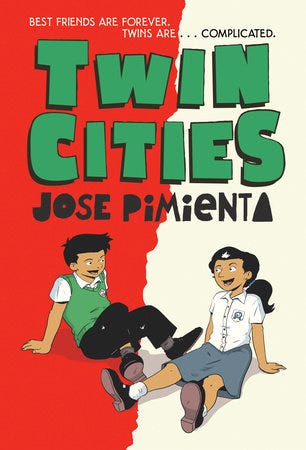
Twins Fernando and Teresa are about to start middle school. Referred to collectively as the Lu-lus, Teresa wants to start an independent life with her own identity. They opt to go to different middle schools. Fernando will remain at the middle school in Mexicali, their Mexico border town, and Teresa decides to cross the border everyday to attend a private catholic school in the United States. The transition to middle school is bumpy. Teresa is finding the commute difficult, the workload intense, and family life stifling. That said, she is making friends and enjoying her teachers and learning. Fernando is having an opposite experience. He has plenty of free time, but no friends to enjoy it with and feels lonely with his sister’s time being limited. Fernando finally meets a fellow loner who introduces him to great Mexican music and movies—and also pressures his into risky behaviors. Fernando is faced with a choice: Does he lose his only friend or do what he knows is wrong? How will the twins settle into their new chapters in life and learn to cope with both outside challenges and those within their own little family?
Author and illustrator Pimienta draws from his own experiences as a child growing up in Mexicali and being faced with a similar decision, of which he and his siblings all made different choices and had different experiences. Themes are explored about what it means to be truly Mexican, sibling relationships, growing up, and peer pressure. Written in English, it is assumed that the characters are usually speaking Spanish and Pimienta explains his decision to write in English instead of a hybrid. That said, Spanish words and terms are sprinkled throughout. The comic illustrations are a bit more elevated than the usual fare for kids and some of the panels scanned non-traditionally, indicating to readers that this is for older elementary. Speaking of which-this is why I read the book. A parent complained to me that the book is not appropriate for children and should be shelved in the teen section. After carefully reading it, it think it does belong in the children’s room, but is skewed for an older elementary audience. There is no romance or strong language. The objection must have sprung from Fernando getting pressured to smoke pot, trying it, and realizing it was a bad decision. It serves more as a cautionary tale of what not to do (much like an afterschool special), but is not for littles. I really enjoyed this book and think that is important on many levels. Young readers must agree with me because our copy is literally falling apart after less than four years. Hand to fans of Raina and other realistic graphic memoirs.